

The Vauxhall Nova SR always lived in the shadow of its fuel-injected, more powerful sibling the Nova GTE. The GTE was the poster car. The SR was the attainable one.
In the mid-1990s, that mattered. The SR was affordable and everywhere. It was frequently modified with lowered suspension, larger alloy wheels, a big box rear exhaust, free flow air filter, tinted rear lights and oversized speakers in the rear parcel shelf. Many were written off, stolen or simply worn out. Joyriding was common and few cars survived that era unscathed.
Rust accelerated the decline. Rear arches, sills, door bottoms and front panels were all vulnerable. At the time, these were disposable cars. Preservation was not a consideration.
That’s why genuinely original examples are now scarce.
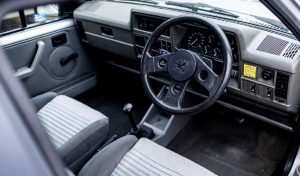
The 1989 Nova SR heading to auction appears to be one of the few that avoided that fate, original, unmodified and showing just 55,600 miles. From the photographs it retains period details, including optional alloy wheels and what appears to be the correct Philips radio cassette unit. That level of originality is increasing rare.
This car is being offered by Historics Auctioneers at is upcoming sale.
Why So Few Survived
Three factors reduced numbers dramatically:
- Modification culture
- Theft and write-offs
- Corrosion
The Nova was a strong seller for Vauxhall but it was never treated as a future classic. It was good value for the money “warm ish” performance transport. Most were used hard and discarded.
Vauxhall values have also traditionally trailed equivalent Fords in the collector market. That pricing gap still exists but it may not reflect true rarity anymore.
The Price Question
This example carries a guide of £10,000 – £15,000.
In October last year, a 1987 Nova SR with just under 68,000 miles sold for £14,000 at Mathewsons Auctions. That sale provides a useful benchmark for strong, original cars.
This car is newer and has covered fewer miles than the example just described that sold for £14,000 last October. In that context, a £10,000 – £15,000 guide does not look ambitious. If condition matches the description, it may even prove a bit low.
Who Is Buying?
Cars like this tend to appeal to:
- Enthusiasts now their 40s and 50s reliving early driving years
- Collectors prioritising originality over outright performance
- Buyers who see late 1980s and early 1990s analogue cars as increasingly rare.
Vauxhall values still look modest compared to equivalent Fords, which creates a perception of relative value within the market.
Final Thought
If originality and condition are as strong as they appear, the guide looks sensibly pitched against recent results.
The result will tell us whether the market is genuinely strengthening or whether nostalgia still has limits.
About the author
Sheridan is an independent automotive editor and founder of We Blog Any Car. With over 30 years’ experience in the motor industry, his work focuses on market insight, buying signals, and real world automotive analysis, with a particular interest in the modern classic market.



Leave A Comment