
This article contains affiliate links. We Blog Any Car may earn a commission if you make a purchase.
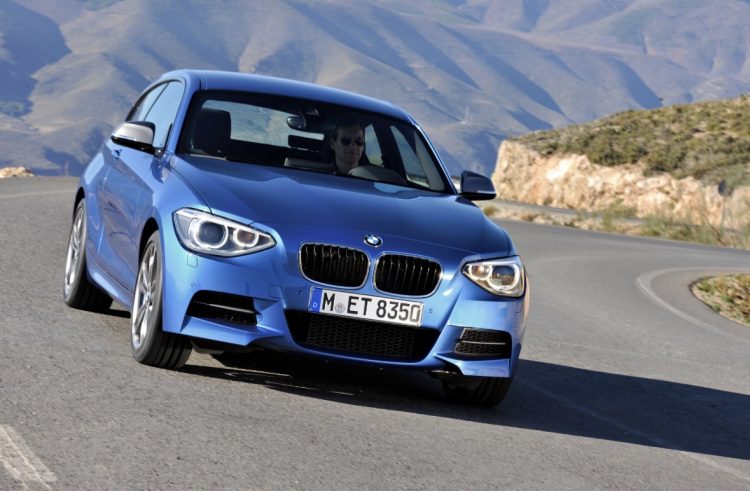
BMW M135i (F20/F21) was introduced in 2012 with the last cars registered around 2016. Used prices are starting from around £8,500 if you don’t mind a earlier higher milage one. It represents one of the most accessible ways into the 3.0 litre turbocharged straight-six engine that produces around 315bhp in standard form.
On paper, a M135i makes a lot of sense.
One criticism from me is its visual identity. You could spec a 118d with an M Sport package and to most people it looks almost the same. The differences are subtle: the M135i doesn’t have fog lights lower down in the front bumper but does have two exhausts pipes either side at the rear, grey door mirror caps and blue brake calipers. If you were expecting visual drama, you won’t find it here.
But that is missing the point.
The appeal of the M135i starts the moment you start the engine. At low speeds, it’s smooth and surprisingly refined. It will quite happily drive like a normal hatchback. Switch it into Sport mode and the character sharpens straight away.
This is a car that covers ground very quickly when asked.
More importantly, it delivers something that’s increasingly rare. A relatively compact, rear wheel drive BMW with a straight six engine.
It’s about as close as you’ll get to a modern analogue driving experience in this price range.
It is also useable, available in both three and five door form and can offer a level of practicality that makes it viable as a daily.
This is where most buyers can get it wrong. Condition and history matter far more than specification or “go faster bits”.
A cheap M135i is rarely a good one.
Focus on cars with strong service history with evidence of consistent maintenance. Both the manual and 8 speed ZF automatic are generally good but neglect will show in how the car changes gear.
Speaking with independent BMW specialists, the general word is that both the engine and transmission are strong. Look for leaking oil from gaskets.
If you’re considering a modified example, proceed carefully. Modifications aren’t necessarily a problem but they must be properly documented and professionally carried out. Cutting corners with modifications or upgrades could possibly cost you later.
Before you go any further with a car, run a proper vehicle history check. You’re looking for outstanding finance, insurance write-offs, mileage discrepancies and strange ownership patterns. These are things that come up more often than people think. Skip this step and it’s very easy to turn what looks like a good buy into an expensive mistake.
When viewing a car, pay attention to the details:
- Check for kerbed or cracked alloys
- Look for signs of poor bodywork repairs
- Listen for clunks or knocks sounds over bumps
- Misfire, check coil pack
- Make sure all interior controls work including the iDrive system
- Check for uneven tyre wear, often a sign of bigger issues
These are not small things. They are signals.
If history is incomplete, the condition raises questions or you are simply unsure, this is where a professional inspection becomes a good idea. Some buyers consider a warranty but only under the right conditions.
A warranty is a contract, not reassurance. Cover varies between providers and the small print matters. For a car like the M135i, it can make sense where there could be exposure to higher repair bills but only if the policy properly covers key components and doesn’t exclude the very failures you are trying to protect against.
If you are considering one, ask three things:
- What is the claim limit per repair?
- Are wear and tear items included?
- Does it cover diagnostics and labour?
If those answer aren’t clear, the warranty has limited value.
Most examples currently sit between roughly £8,000 and £15,000 depending on milage, condition and history. There is no shortage of cars on the market which means you can afford to be selective.
Who should buy one?
Someone who wants to experience a proper BMW straight six with rear wheel drive, in a relatively compact and usable package. It suits a buyer who values balance, performance and subtlety over outright show.
Who should avoid one?
If you are chasing the cheapest performance per pound or if you are buying it purely to stand out, this isn’t the right car for you.

Still considering an Audi S3?
This earlier insight covers real ownership experience, common pitfalls and what doesn’t show up on listings.
About the author
Sheridan is an independent automotive editor and founder of We Blog Any Car. With over 30 years’ experience in the motor industry, his work focuses on market insight, buying signals, and real world automotive analysis, with a particular interest in the modern classic market.









Leave A Comment